General health information
What is Acne?
Acne scars may develop after inflammatory acne, particularly deeper or more severe lesions. During repair, fibrosis or loss of supporting tissue can leave visible depressions.
Contributing factors include severe inflammatory acne, squeezing or picking, genetics, delayed acne care, excess sun exposure, irritating products and unsuitable medicines or creams.
Ice Pick scars are narrow and deep with a pointed opening, often seen on the upper cheeks or forehead.
Boxcar scars are wider depressions with relatively defined edges and shallow-to-moderate depth, commonly on the cheeks, temples or jawline.
Rolling scars have less-defined edges and a wave-like surface, often related to fibrous bands beneath the skin. More than one scar pattern may occur on the same face.
Goals of care
- Control inflammatory acne before further scarring develops
- Distinguish Ice Pick, Boxcar and Rolling scars before selecting a program
- Address pores, post-acne marks and uneven texture according to assessment
- Plan intervals and sessions around the skin response
BEAUTIER PROGRAMS
Acne and acne-mark programs available at the clinic
The clinician assesses acne type, inflammation, redness, pigmentation and scar pattern before sequencing care.
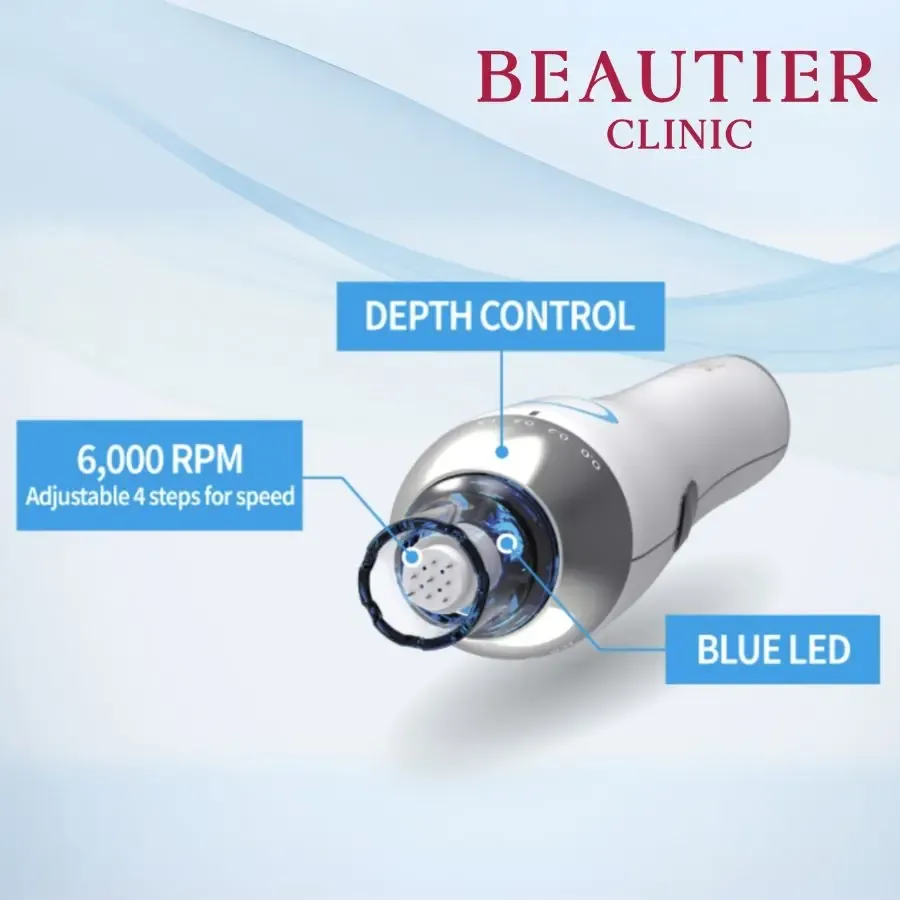
Microneedling Pen
A microchannel program that supports the skin’s natural repair process, planned from the acne-scar pattern and skin assessment.
- Adjustable needle depth of approximately 0.5–2.0 mm
- Adjustable speed from 3,000–6,000 RPM
- Integrated blue LED light
- Depth, speed, accompanying product and session plan are selected individually

Microneedling – Dermapen & GENOSYS CTS + Clinic Patent
Beautier Clinic combines a Microneedling Pen with GENOSYS CTS and the clinic’s signature vitamin formula for acne scars, pores, acne marks and texture.
Depth, speed, accompanying products and session count follow the scar pattern and skin sensitivity.
- GENOSYS CTS contains selected extracts and components intended to support skin repair and collagen-related processes
- The clinic vitamin formula forms part of an individualized plan for specific skin concerns
- Microneedling creates microchannels so clinician-selected products reach the planned skin level
- Program goals may include acne scars, pores, acne marks, smoothness and dull-looking skin
- The product has a history of use in Thai clinics and Thai FDA registration; its label, registration and condition are verified before use
Active inflammatory acne should be assessed and controlled before a scar program. Outcomes, sessions and recovery vary between individuals.
General health information
Who should begin with an assessment?
Assessment helps clarify goals, identify precautions and avoid unnecessary procedures.
- 01
Narrow deep, defined-edge or wave-like acne scars
- 02
Visible pores or uneven texture with post-acne marks
- 03
Inflammatory acne that has settled before scar assessment
- 04
Previous acne-scar care requiring a continuing plan
General health information
Assessment and care planning
Our team considers active acne, scar pattern and depth, fibrous tethering, skin tone and sensitivity, previous treatment and healing history, medical history and realistic expectations together.
01 — Goals and history
Review concerns, previous care, medical conditions, medicines and allergies.
02 — Structured assessment
Consider the skin, anatomy or other relevant factors before selecting an approach.
03 — Plan and follow-up
Explain options, limitations and risks, then arrange appropriate follow-up.
General health information
Preparing for and caring for skin after Microneedling Pen
Before treatment
- Pause exfoliating products such as vitamin A or retinoids, AHA and BHA for at least three days or as advised
- Share regular medicines, NSAIDs, medicines or supplements that may affect bleeding, and allergies; do not stop prescribed medicines on your own
- Avoid laser treatment, waxing or shaving in the area for around two weeks, and mention pregnancy or breastfeeding
- Avoid alcohol, smoking and vigorous activity for three days beforehand
After treatment
- Keep the area clean and avoid touching, picking or scratching
- Avoid make-up and skin-care products for around 48 hours or follow the individual instructions provided
- Clean the skin as instructed and avoid irritating products
- Limit sun exposure and introduce sun protection when the skin is ready, as advised by the team